The Ananga Ranga Sex Positions — Part 1 (131–155)
Twenty-five positions from Kalyana Malla's 15th-century Sanskrit treatise — the text written for one specific purpose: keeping married couples from drifting apart.
The Text Written to Save Marriages
The Ananga Ranga — "Stage of the Bodiless One," a name for Kama — was written by the poet Kalyana Malla around the 15th or 16th century, roughly a thousand years after Vatsyayana. What sets it apart is its stated purpose. Kalyana Malla wasn't cataloguing human sexuality in general; he was writing for married couples specifically, on the argument that boredom within marriage was what drove partners toward infidelity, and that variety was the cure.
That practical goal shapes everything. The text is heavily weighted toward seated positions, as this section shows — arrangements that keep both partners facing each other, leave hands free, and consistently hand pace and control to the woman. It repeatedly recommends conversation during intimacy, and it favours positions that need no bed, no strength, and no special setting.
Sir Richard Burton produced the first English translation in 1885 — a year before his Perfumed Garden and two years after the Kamasutra, making him the conduit through which all three classical traditions reached the West.
On the Demanding Positions
Three entries — Kalyana Table, The Keen Rider, Bridge of Pleasure — need real strength or flexibility, and the text says so itself. Attempt briefly, stop at any strain, and skip freely. The remaining twenty-two need nothing but a floor and some time.
The Twenty-Five Positions

The Ananga Ranga opens its seated sequence with the lotus — he sits in the folded padmasana posture and she settles astride his lap, facing him. What the text emphasises is proximity rather than mechanics: this produces the closest full-body embrace of any position in the catalogue, with both partners' arms free to hold. She controls the movement while he provides the stable base. Because it needs no furniture, Kalyana Malla notes it suits places where no bed is available, and the fold should never be forced — sitting cross-legged achieves nearly the same geometry without knee strain.
✨ Divine moment: The closest embrace in the whole catalogue.
🌙 Pure nirvana: Adjust your legs to give her room.



He sits with legs stretched and parted; she settles between them, spreads her legs either side of his hips, and leans back onto her hands. He supports her lower back with his hands throughout — that support is what makes the backward arch sustainable rather than strenuous. The arch opens the angle substantially and leaves both partners' torsos visible to each other. The text recommends water settings, and the buoyancy genuinely helps here, since it takes weight off the arms holding the lean.
✨ Divine moment: Support her back so she can lean freely.
🌙 Pure nirvana: The arch is the whole position.

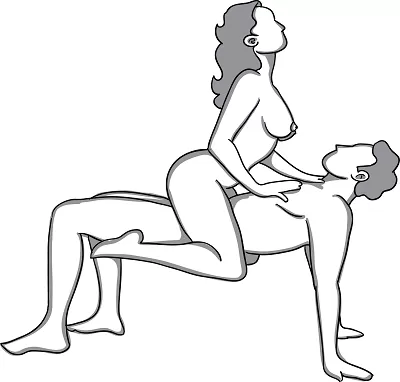
He raises himself on hands and feet to form a stable platform; she straddles him and sets the entire pace. The text is explicit that he becomes a passive participant here — his job is to hold the structure, nothing more. It demands real endurance from him and works best in short intervals. Of the female-led positions in the Ananga Ranga this is the most physically committed, and Kalyana Malla places it early precisely to establish that the woman's control is central to the whole text rather than an occasional variation.
✨ Divine moment: He holds the platform; she does everything else.
🌙 Pure nirvana: Short intervals — it's harder than it looks.



He kneels; she sits on his lap with her legs around his body, faces level. The name signals the register rather than any requirement — the text presents it as the position for tenderness and first encounters, where slowness matters more than depth. Both partners' mouths and hands are free, and the arrangement supports the stop-start pacing the Ananga Ranga repeatedly recommends: build, pause, talk, resume. Among the most emotionally weighted entries in the catalogue.
✨ Divine moment: Faces level — talk as much as you move.
🌙 Pure nirvana: Pause, then begin again.

He sits on the floor; she wraps herself fully around his body, legs behind his back, and both hold each other tightly. She sets the pace through the wrap. What distinguishes it from the Lotus is the completeness of the enclosure — arms and legs both engaged on both sides — which produces maximum skin contact for a seated arrangement. The text notes his access to her neck and back, and the feedback loop that creates: attention there changes her rhythm noticeably.
✨ Divine moment: Attention at her neck changes her rhythm.
🌙 Pure nirvana: Full wrap, both sides, no gaps.


He sits on a low box, chair or bed edge; she settles onto his lap and leans in for kissing. The furniture is what distinguishes it from the floor-seated positions — a raised seat changes the angle and takes strain off both sets of legs, making it sustainable far longer. The Ananga Ranga frames it as a position for sudden urgency, which fits: it requires no arrangement beyond finding something to sit on.
✨ Divine moment: A raised seat changes everything.
🌙 Pure nirvana: Kissing throughout — that's the design.



He kneels while she lies with her hips near him and her legs encircling his waist. As arousal builds she raises and parts her legs further — the movement the name describes, and which the text reads explicitly as communication rather than mechanics. This is the Ananga Ranga's recurring method: positions are described through the signals partners exchange within them. Unplanned by design, and it requires nothing but the floor.
✨ Divine moment: Her leg movement is the invitation.
🌙 Pure nirvana: Let her set how far it opens.

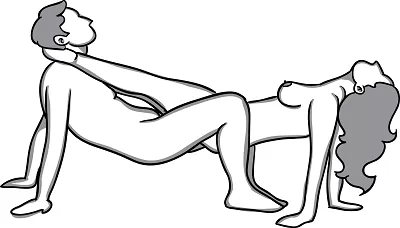
Both partners support their weight on their hands with legs resting on each other's shoulders, forming the six-legged table the name describes. It requires genuine strength and endurance from both and the text presents it frankly as an experiment rather than a staple. Attempt briefly, come out of it the moment either feels strain, and treat skipping it entirely as reasonable — a 500-year-old catalogue records what is possible, not what is expected.
✨ Divine moment: Both of you holding the structure.
🌙 Pure nirvana: Brief experiment, then something kinder.

He sits with legs stretched and slightly parted; she sits on his lap, falls back holding his legs for support, and encircles her legs behind his back. Both contribute movement — hence the name, and it's a deliberate one in a text otherwise attentive to who leads. His hands remain free at her front. The mutual arrangement means small movements from either partner travel through the whole position, which is what the Ananga Ranga means by equality here.
✨ Divine moment: Neither of you is leading.
🌙 Pure nirvana: Small movements travel further than you'd think.


Both sit facing each other, leaning back on their hands, legs scissored through each other's. The Ananga Ranga singles it out as the position requiring the least effort of any in the catalogue — deliberately unstrenuous, built for conversation and slow movement rather than intensity. Both partners can see each other completely, which the text treats as the point. For couples winding down rather than winding up, this is the entry to reach for.
✨ Divine moment: The least effortful position here, by design.
🌙 Pure nirvana: Stay locked together longer than planned.

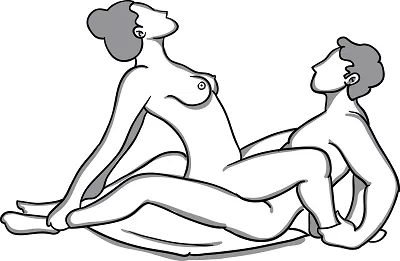
She sits on his lap and both partners grip each other's ankles behind — the mutual hold that gives the position its name and its stability. Nothing shifts once the grip is established, which is precisely the appeal: she controls pace and depth entirely without either partner working to hold the arrangement. The text describes it as a bondage of sorts, achieved through position alone rather than any equipment.
✨ Divine moment: A hold that needs no equipment.
🌙 Pure nirvana: Nothing shifts once you're locked.

He sits with legs stretched; she sits astride, leans back with hands on the floor between his legs, and rests her legs on his shoulders. He holds her hips. The combination — leaning back while legs go forward over the shoulders — produces one of the deepest angles achievable seated, which is what the name refers to. She controls the movement and pace throughout; his role is to hold her securely so she can commit to the lean.
✨ Divine moment: Hold her firmly so she can lean fully.
🌙 Pure nirvana: She sets the pace entirely.

Both sit facing each other, close enough that hips almost touch, each leaning back on their hands. Her legs rest on his shoulders; his bend behind her back. The Sanskrit upavishta simply means seated, and this is the archetypal seated congress the classical texts describe. Because both partners are braced behind, neither has free hands — the text notes this makes it unusually visual, with each partner watching the other throughout.
✨ Divine moment: Neither of you has a free hand — just watch.
🌙 Pure nirvana: Move together from the hips.

He sits with legs stretched and draws her close, hugging her folded legs against his chest while she arches back onto her elbows. Hugging the knees is what stabilises the whole arrangement — it holds her position without either partner straining, which is why the text recommends it for unplanned encounters. The angle it produces is notably deep for a seated position, and it adapts equally well to floor or bed.
✨ Divine moment: Hugging her knees holds everything steady.
🌙 Pure nirvana: Deep angle with almost no effort.

She sits on his lap with one leg pressed behind his back and the other lifted into the air. The asymmetry is the mechanism — raising one leg alters the angle in a way no symmetric seated position achieves, and she can adjust the height continuously to find what works. He holds her body while she controls the rise and fall. Kalyana Malla notes it suits outdoor and improvised settings, since it needs only a surface to sit on.
✨ Divine moment: The raised leg finds the angle.
🌙 Pure nirvana: She adjusts height continuously.

He sits with legs stretched; she sits on his lap and lies back over his legs, resting her feet on his thighs while he hugs her bent knees to his chest. The rowing metaphor describes the movement precisely — a rhythmic pull-and-release from the torso rather than the hips. Both partners hold each other's legs for support, and the text notes the arrangement lets her simply lie back and receive, which few seated positions allow.
✨ Divine moment: The motion really is like rowing.
🌙 Pure nirvana: She lies back and does nothing at all.
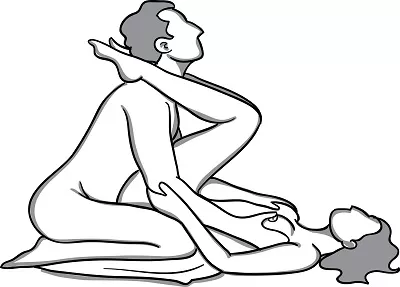
She lies on her back and rests both feet on his shoulders, forming the Z-shape the text describes; he kneels and holds her for support. This is among the deepest-contact positions in the Ananga Ranga, which means depth should be found gradually here rather than assumed — the text's own framing is that she guides how far it goes. Reasonable flexibility required, and a cushion under her hips makes the angle considerably more comfortable.
✨ Divine moment: The Z-shape is the whole geometry.
🌙 Pure nirvana: Gradual depth, always.

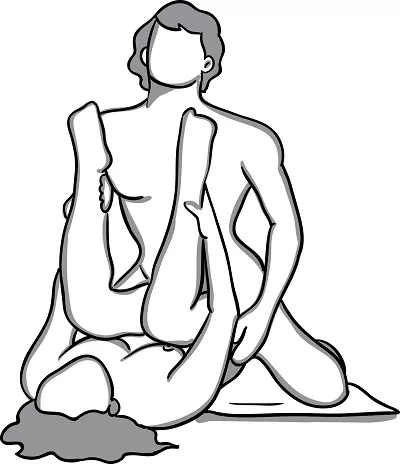
A close variant of the Level-Feet: rather than feet on shoulders, she bends her knees more and rests her legs against his chest. He kneels with knees spread and holds her legs or hips. The text catalogues it separately because the sensation genuinely differs — chest contact rather than shoulder contact changes the angle noticeably, and it demands markedly less flexibility, making it the more accessible of the pair.
✨ Divine moment: Less flexibility, comparable angle.
🌙 Pure nirvana: The accessible version of 147.

She lies back with legs lifted and held close to her body; he kneels low, bracing his hands on the surface. The Ananga Ranga associates this with reunion after separation — a position for when partners have been apart. The folded-knee arrangement produces a close fit that doesn't shift, and both partners' faces remain close enough for eye contact throughout, which is unusual for a position with this much depth.
✨ Divine moment: Close fit, close faces — both at once.
🌙 Pure nirvana: The position for coming back together.

He positions on all fours; she lifts her torso and cuddles his body with her legs, holding on with the leg grip that gives the position its name. The text calls it freakish and means it affectionately — this is one of the catalogue's genuinely playful entries. Her leg grip controls how close he stays and, by extension, the pace. Attempt it with some humour; the Ananga Ranga clearly intended it that way.
✨ Divine moment: Her leg grip decides when you move.
🌙 Pure nirvana: This one is meant to be fun.

She sits on his lap and, as arousal builds, falls back to lie flat along his lap with legs stretched. He holds her hips and moves from the groin. The transition is the point — the position evolves out of a simple seated embrace rather than being arranged, which is how the text describes most of its favourites. Both hands free at her hips, and the reclining angle is comfortable enough to sustain for a long stretch.
✨ Divine moment: The position arrives on its own.
🌙 Pure nirvana: Comfortable enough to stay indefinitely.

She lies on her back and raises her knees toward her chest; he kneels to meet her. The Ananga Ranga's practical note here is the useful part — use a pillow to get the height right. That single adjustment transforms the angle at no cost in effort, and the text mentions it plainly rather than assuming ideal anatomy. Her legs held closer produce a tighter fit; she controls that entirely.
✨ Divine moment: One pillow gets the height right.
🌙 Pure nirvana: She decides how close her knees come.

He kneels and lifts her torso from the surface, holding her hips; she braces her toes against his calves for grip. The lift is what defines it and what makes it demanding — her weight is partly on his arms throughout. The text is unusually direct that couples who aren't reasonably fit will find this uncomfortable, which is worth heeding. Best in intervals, with her toe-grip doing more of the work than it appears to.
✨ Divine moment: Her toes on your calves take real weight.
🌙 Pure nirvana: Intervals, not sustained.
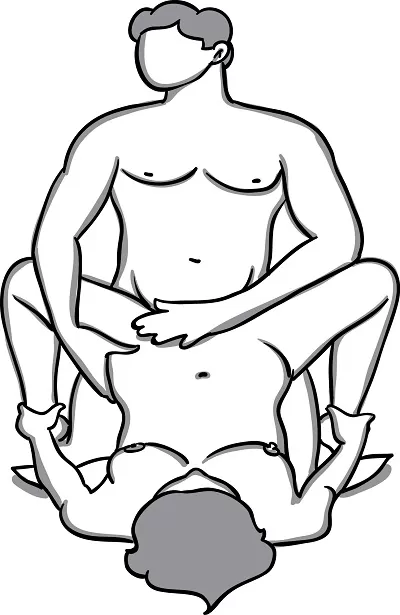
She rests on her shoulders and lifts her hips, holding her own legs to form the bridge; he kneels and draws her close, holding her hips. Her self-hold is essential — the text notes plainly that without it the position can't be sustained. Movement should be slow and gentle here rather than vigorous, both because of the elevation and because the shoulder-stand element makes sudden movement uncomfortable. Come out of it gradually.
✨ Divine moment: Her own hold is what makes it possible.
🌙 Pure nirvana: Slow and gentle throughout.

She lies back with legs raised; he kneels and, rather than interlacing fingers, rests his open palms flat against hers. The palm contact is the entire distinguishing feature — a small, oddly intimate detail that the Ananga Ranga thought worth cataloguing. The text describes it as a position full of talking and laughter, and it closes this section on exactly that note: intimacy doesn't have to be solemn to be meaningful.
✨ Divine moment: Open palms, not interlaced fingers.
🌙 Pure nirvana: Laughter belongs here.
⭐ The Twenty-Five at a Glance
| # | Position | Type | Level | Pair With |
|---|---|---|---|---|
| 131 | The Lotus Position | Seated | Intermediate | KamaSutra Dotted → |
| 132 | Crest of a Wave | Seated | Intermediate | KamaSutra Longlast → |
| 133 | The Keen Rider | Her Control | Advanced | KamaSutra Ribbed → |
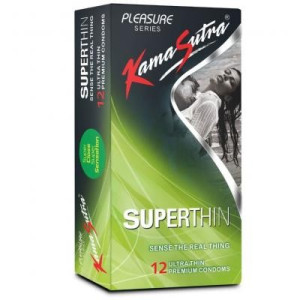
| 134 | Position of Virgins | Kneeling | All Couples | KamaSutra Superthin → |
| 135 | Accomplishing Position | Seated | All Couples | Manforce Bubblegum → |
| 136 | The Honourable One | Seated on Edge | All Couples | Manforce Litchi Flavoured → |
| 137 | The Invitation | Kneeling | Intermediate | Manforce Stay Long Spray → |
| 138 | Kalyana Table | Acrobatic | Expert Only | Manforce StayLong Gel → |
| 139 | Position of Equals | Seated | Intermediate | Manforce Epic Lube → |
| 140 | Full Moon Vigil | Seated | All Couples | Moods Natural Lube → |
| 141 | Snake Trap | Seated | Intermediate | Moods All Night (Delay) → |
| 142 | The Crying Out Position | Seated | Advanced | Moods Premium Dotted → |
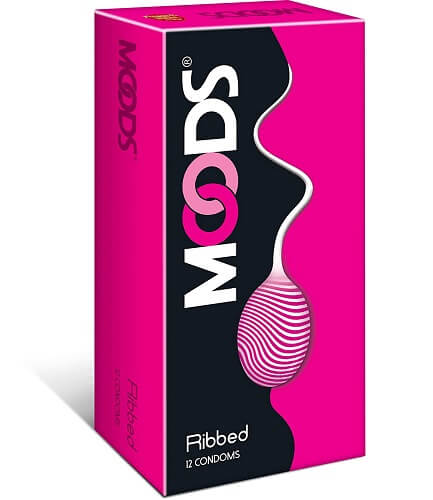
| 143 | Upavishta — Seated Congress | Seated | Intermediate | Moods Premium Ribbed → |
| 144 | Paired Feet Position | Seated | All Couples | Moods Ultrathin → |
| 145 | The Rising Limb | Seated | Intermediate | Okamoto 0.02 Ultra Thin → |
| 146 | The Boat Man | Seated | Intermediate | Okamoto Skinless Skin → |
| 147 | The Level-Feet Position | Kneeling | Advanced | Skore Dots Condoms → |
| 148 | The Praiseworthy Woman | Kneeling | Intermediate | Skore Not Out (Delay) → |
| 149 | Passion Stoker | Kneeling | Intermediate | Carex Hammer Vibe Ring → |
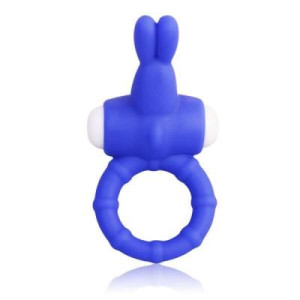
| 150 | The Monkey Embrace | All Fours | Intermediate | Carex Rabbit Vibe Ring → |
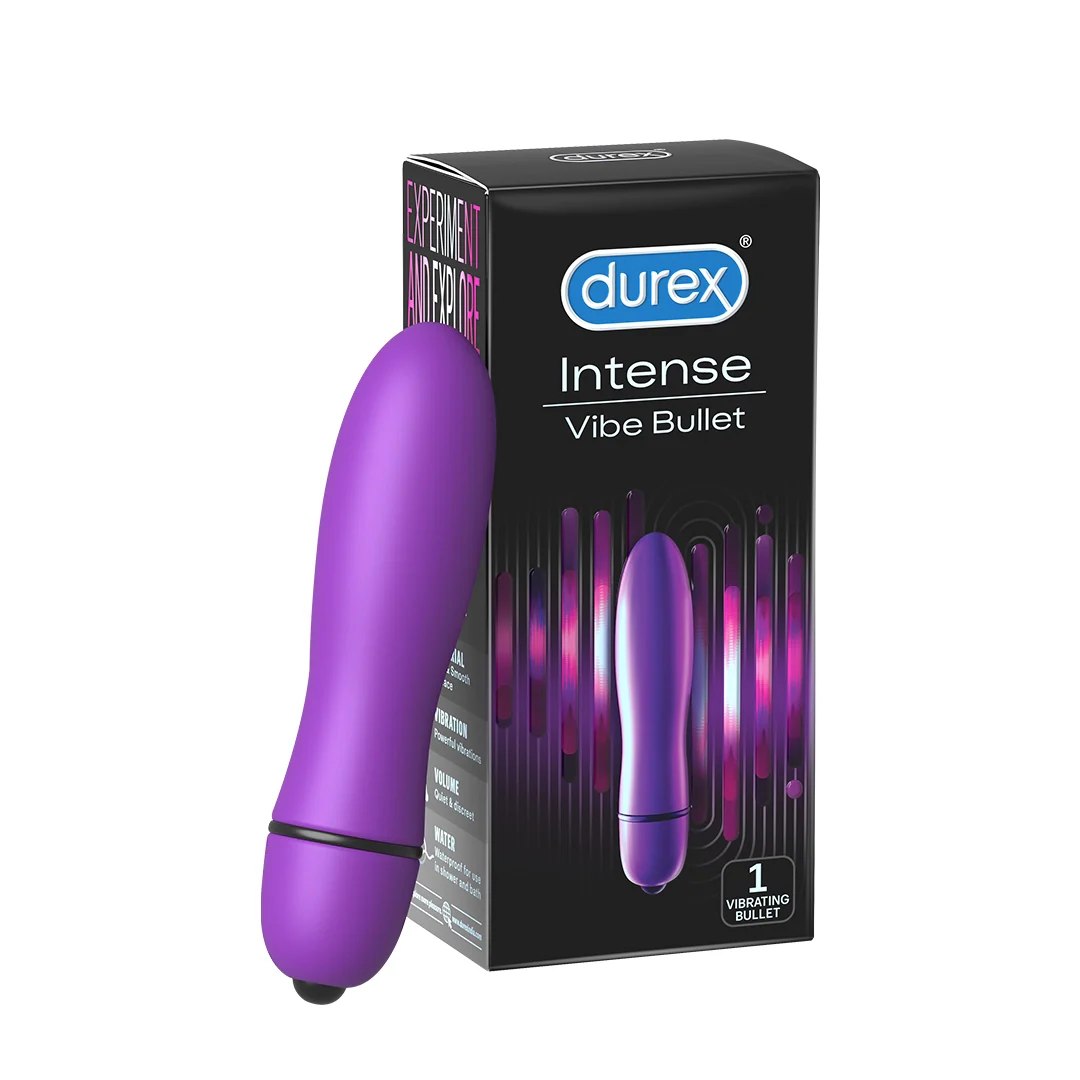
| 151 | Parallel Motion | Seated | All Couples | Durex Intense Vibe Bullet → |
| 152 | Raised Feet Position | Kneeling | All Couples | Extreme O Bullet Vibe → |
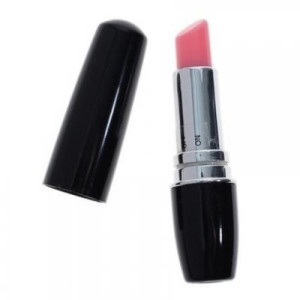
| 153 | The Refined Position | Kneeling | Advanced | Lipstick Massager → |
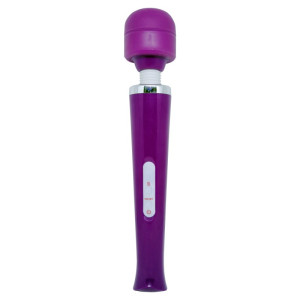
| 154 | Bridge of Pleasure | Elevated | Advanced | Magic Massager Wand → |
| 155 | The Palmist | Kneeling | All Couples | Air Hostess Costume → |
Shop by Category




Reading Kalyana Malla Today
Of all the classical manuals, the Ananga Ranga is the one with a thesis — that couples who stop exploring together stop wanting each other, and that this is preventable. Five centuries on, relationship research broadly agrees: novelty and shared new experience correlate strongly with sustained desire in long partnerships. The twenty-five positions here are the method; the argument behind them is what makes the text worth reading. Part 2 continues the catalogue.
Frequently Asked Questions
What is the Ananga Ranga?
A Sanskrit treatise written around the 15th–16th century by the poet Kalyana Malla, roughly a thousand years after the Kamasutra. Its purpose was unusually specific: Kalyana Malla wrote it to prevent married couples from drifting apart, arguing that variety within marriage was the remedy for the boredom that pushes partners toward infidelity.
How does it differ from the Kamasutra?
The Kamasutra is a broad treatise on living well, addressed to society generally. The Ananga Ranga is narrower and more practical — aimed squarely at married couples, and heavily weighted toward seated positions (as this section shows) rather than the supine postures the Kamasutra catalogues first.
Why are so many of these positions seated?
Seated congress lets both partners face each other, keeps hands free, and hands pace to the woman — all things the text values. Kalyana Malla also notes seated positions need no bed, which suits the improvised and outdoor settings he repeatedly mentions.
Which of these should beginners try first?
Position of Virgins (134), Full Moon Vigil (140) and The Honourable One (136) require no strength or flexibility — Full Moon Vigil in particular is described in the text as the least strenuous of them all. Kalyana Table (138), The Keen Rider (133) and Bridge of Pleasure (154) sit at the opposite extreme.
Was it translated by the same person as the Kamasutra?
Yes — Sir Richard Francis Burton produced the first English edition in 1885, a year before his Perfumed Garden translation and two years after the Kamasutra. All three reached English readers through the same Victorian explorer-scholar.
Is delivery from Condombazaar discreet?
Completely. Every order ships in plain, unmarked packaging with sender name CA Gain Healthcare — no product name or brand visible anywhere on the box. Delivering privately across India since 2010.
Related Guides
Was this guide useful? Share it: