The Perfumed Garden Sex Positions — Part 1 (183–200)
Eighteen positions from al-Nafzawi's 15th-century Arabic manual — the work Richard Burton translated alongside the Kamasutra, and the one far fewer people have read.
About The Perfumed Garden
The Perfumed Garden of Sensual Delight was written by Muhammad ibn Muhammad al-Nafzawi somewhere between 1410 and 1434 — roughly a thousand years after the Kamasutra, in Arabic rather than Sanskrit, and with a markedly different temperament. Where the Indian text is philosophical, al-Nafzawi is practical to the point of bluntness: alongside positions he catalogues remedies for sexual difficulties, guidance on health, advice on attraction, and even a section interpreting dreams.
It reached English readers through Sir Richard Francis Burton's 1886 translation — the same explorer-scholar who brought the Kamasutra to the West. Burton himself compared it to the French manual Conjugal Love, and modern sexologists still credit the book's central insistence on compatibility between partners.
The text has fair criticism against it: written from within 15th-century Arabian society, it takes an unmistakably male perspective. Worth noting, though, that al-Nafzawi insists a man must genuinely win a woman rather than expect compliance — and that two of the positions below hand her control of the encounter outright. Read our full introduction to the text →
A Note on the Demanding Positions
Several entries here — Meeting of the Organs, Gripping with Toes, The Sacred Arch — require real strength or flexibility. Attempt them briefly, stop the moment either partner feels strain, and treat skipping them entirely as a completely reasonable choice. A 600-year-old manual is a catalogue, not a checklist.
The Eighteen Positions

Al-Nafzawi opens his catalogue with the position requiring no instruction at all — and says so explicitly. She lies on her back with legs open; he lies above her, weight taken on his hands placed near her shoulders, legs extended behind. The text's reasoning for placing it first is characteristically practical: a manual should begin with what a couple will find naturally, then build outward. Face-to-face contact throughout allows eye contact, kissing and conversation, and the body-to-body pressure provides stimulation for both partners simultaneously. Everything that follows in the chapter is, in one way or another, a variation on this arrangement.
✨ Divine moment: The position needs no learning — that's why it's first.
🌙 Pure nirvana: Full face-to-face contact, unhurried.



One of the more physically demanding entries in the chapter. He holds a raised push-up position on extended arms; she lies beneath and raises her pelvis to meet him, bending her knees for grip and holding his shoulders for stability. The movement comes from lowering the hips rather than the whole body, which is what makes it genuinely strenuous. The text notes the humour in it, and modern couples usually agree — this is a position that produces laughter as readily as anything else, which is precisely its value. Best attempted early in a session rather than late.
✨ Divine moment: Laughter belongs here as much as anything else.
🌙 Pure nirvana: Finish somewhere considerably less athletic.



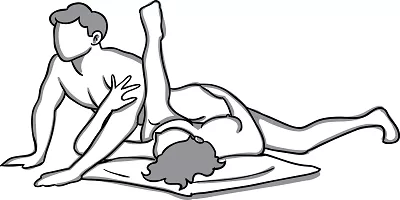
The distinguishing feature is the diagonal approach — rather than aligning bodies in parallel, he positions himself across her at an angle. She lies with one knee drawn up toward her chest and the other leg extended; he lies diagonally across her body, supporting himself on one hand. The altered angle is the entire point: it produces contact patterns that neither partner will recognise from conventional positions. Al-Nafzawi's catalogue is full of this logic — small geometric variations treated as distinct entries because the sensation genuinely differs. She can guide the angle with a hand at his back.
✨ Divine moment: A completely unfamiliar angle changes everything.
🌙 Pure nirvana: Let her guide the direction with a hand.


He kneels on all fours with one hand supporting his weight and the other holding her hips in position; she lies beneath, lifts her torso, and hooks her legs around his back so that her lower body is effectively suspended. The name refers to the toe grip she uses to lock the hold. It demands genuine core strength from both partners and works best in short intervals rather than sustained, but the depth of contact it achieves is why the text includes it. A cushion beneath her shoulders makes the arrangement considerably more sustainable.
✨ Divine moment: The suspended hold, held only as long as it's comfortable.
🌙 Pure nirvana: Come down into something restful afterward.




She lies on her back with legs raised; he kneels before her, holding her hips for support and stability. As the position settles, she crosses her legs behind his back and draws him closer, using the leg lock to control depth and pace — a detail the text specifically highlights, since it hands her real influence over the encounter. Al-Nafzawi recommends outdoor settings for this one, and there's practical sense in it: the kneeling arrangement adapts well to surfaces where lying flat isn't comfortable.
✨ Divine moment: Her leg lock sets the pace, not yours.
🌙 Pure nirvana: A setting neither of you will forget.


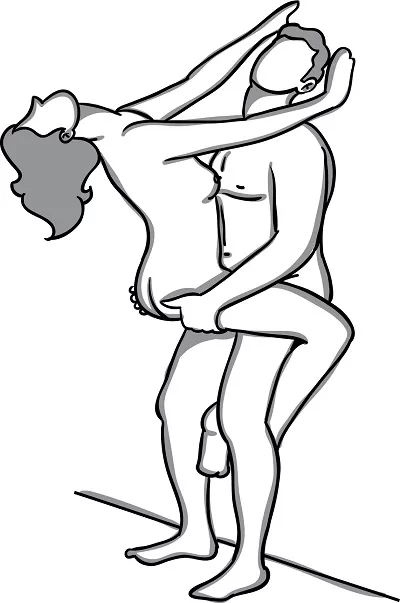
The standing position of the chapter, and the one al-Nafzawi frames as arising from urgency rather than choice. He lifts her; she twines her legs around him; he leans back against a wall to distribute the weight. The wall is not optional — it's what makes the position sustainable beyond a few seconds, and the text's instruction to lean against one is unusually practical advice for a 15th-century manual. Reversing the lean, so she takes the wall instead, redistributes the effort and lets the position last considerably longer.
✨ Divine moment: The wall does more work than either of you.
🌙 Pure nirvana: Swap who leans and start again.




He rests on hands and knees with legs extended behind; she lies beneath and raises her pelvis to meet him, moving her torso to control the angle. The name in translation suggests staying close rather than roaming — apt, since the position keeps both partners' faces near each other throughout. Al-Nafzawi notes the conversational quality this allows, and it's the position's real strength: sustained eye contact and the ability to read each other's expressions make it one of the more communicative entries in the chapter.
✨ Divine moment: Watching each other's face throughout.
🌙 Pure nirvana: The circular motion the text specifically recommends.

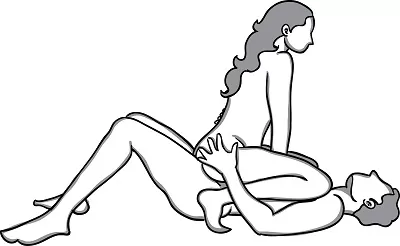
He leans back with legs spread and knees bent; she sits astride him with legs crossed, controlling pace, depth and angle entirely. The text is unambiguous that his role here is to yield it — a notable position for a manual so often criticised for its male perspective. The seated arrangement lets her find the precise contact she wants and sustain it, which is why this position appears in nearly every classical sexual text across cultures under one name or another.
✨ Divine moment: She controls everything. That's the instruction.
🌙 Pure nirvana: Stay passive longer than feels natural.


She lies on her back and raises her legs; he flattens them toward her body with his weight as he moves above her. Raising the legs shortens the effective angle and increases depth of contact considerably — the mechanical reason this arrangement appears across so many classical texts. Flexibility varies enormously between individuals, so the height of the leg raise should follow her comfort rather than any diagram. A cushion under the hips achieves much of the same effect with far less strain.
✨ Divine moment: Depth changes entirely with leg position.
🌙 Pure nirvana: Adjust the angle until she says stop.



She lies on her back with legs raised; he lies above with arms extended for support, and she wraps both arms and legs around him to hold the position steady. The wrapping is the defining element — it prevents the shifting and slipping that interrupts other arrangements, which is presumably why al-Nafzawi called it pleasing. It also produces near-total body contact while keeping both faces close enough for conversation, making it one of the chapter's most straightforwardly comfortable entries.
✨ Divine moment: Fully wrapped, nothing shifting.
🌙 Pure nirvana: Close enough to talk the whole time.



A close relative of the Second Posture, distinguished by drawing her knees up toward her chest rather than flattening the legs outward. The text treats it separately because the sensation genuinely differs — the knee position alters the angle of approach noticeably. This is among the deepest-contact arrangements in the chapter, which makes communication about comfort more important here than in most: depth should be found gradually rather than assumed.
✨ Divine moment: Knees drawn close, angle completely altered.
🌙 Pure nirvana: Find the depth gradually, together.


She lies on her back and rests one leg on his shoulder while the other stays extended; he positions himself with one leg stretched and one knee bent. The asymmetry is what distinguishes it — with only one leg raised, the angle of approach shifts sideways rather than deepening straight on, producing a distinctly different sensation. It's also considerably more accessible than the both-legs-raised variants, needing far less flexibility while achieving a comparable change in angle.
✨ Divine moment: Asymmetry produces something symmetric positions can't.
🌙 Pure nirvana: Swap which leg is raised halfway through.



Precisely what the name suggests: the First Posture with roles reversed. He lies on his back; she lies above with legs extended, hands placed near his shoulders, controlling movement entirely while he holds her hips for stability. Al-Nafzawi's framing is explicit — his role is to permit rather than direct. Placing it as a mirror of the opening position is a deliberate structural choice by the author, and it makes the pair worth trying in sequence to feel how differently the same geometry reads from each side.
✨ Divine moment: The same position, entirely different from below.
🌙 Pure nirvana: Try it immediately after the First Posture.


She lies with one leg raised and the other positioned behind his folded leg, which lifts her hips off the surface to rest on his knees; he kneels with one leg raised. The arrangement suspends her lower body a few inches clear of the bed — the defining feature and the reason it demands endurance from both. He supports and stabilises at her shoulders or upper body. Cushions under his knees make a substantial difference to how long this remains comfortable.
✨ Divine moment: Her hips clear of the bed entirely.
🌙 Pure nirvana: Cushions under his knees — trust the advice.

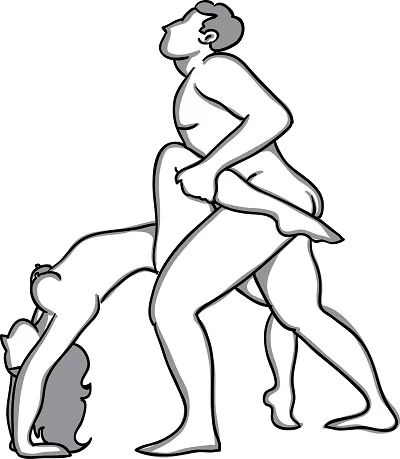
The most demanding position in this part of the chapter, and one al-Nafzawi flags as requiring genuine flexibility and strength. She stands and arches backward, placing her hands on the floor with one leg supporting; he stands between her legs, lifting one of them across his thighs. It's essentially a supported backbend, and it should be attempted only by partners with real flexibility, held only briefly, and abandoned the moment either feels strain. Impressive in the text, difficult in practice — and there's no shame in reading past this one.
✨ Divine moment: Brief, held only as long as it's genuinely comfortable.
🌙 Pure nirvana: Come down and choose something kinder.

She lies with legs extended, resting them over his lap; he kneels and places a pillow beneath her hips to raise the angle. The pillow is the technique — a small adjustment that changes the geometry substantially and costs nothing. The name comes from al-Nafzawi's own metaphor for the closeness of fit the arrangement produces. Of all the positions in this chapter it may be the most immediately practical, requiring no strength, no flexibility, and one household object.
✨ Divine moment: One pillow changes the entire angle.
🌙 Pure nirvana: The easiest position here to actually use.

The author's signature position, and the only one in the chapter bearing his name. Both partners sit facing each other with legs extended, each leaning back on one arm for support, bodies interlocking to form the knot the name describes. He holds one of her legs; both can move. Al-Nafzawi describes it as slow and long-lasting rather than intense — the seated arrangement doesn't permit vigorous movement, which is precisely the point. Complete eye contact throughout, and the text recommends it for relaxed settings where neither partner is in any hurry.
✨ Divine moment: Slow by design — the position won't allow otherwise.
🌙 Pure nirvana: Total eye contact, no rush anywhere.

She lies on her back with legs raised and resting against his torso; he kneels, leaning into her legs for support and holding her thighs for grip. The text notes he should place a pillow under his knees — practical advice that recurs throughout the chapter and is worth heeding. What distinguishes this closing position is stability: the leg-against-torso arrangement locks everything in place, making it one of the most sustainable positions in this part of the catalogue and a natural place for the chapter to rest.
✨ Divine moment: Locked stable — nothing shifts.
🌙 Pure nirvana: A pillow under his knees, as the text advises.
⭐ The Eighteen at a Glance
| # | Position | Type | Level | Pair With |
|---|---|---|---|---|
| 183 | The First Posture | Classical Opening | All Couples | Skore Warm Lube → |
| 184 | Meeting of the Organs | Athletic | Advanced | Okamoto 0.03 Platinum → |
| 185 | Crossing Paths | Diagonal | Intermediate | Skore Cool Lube → |
| 186 | Gripping with Toes | Kneeling | Advanced | KamaSutra LongLast Sync → |
| 187 | Thighs Gripping Abdomen | Kneeling | Intermediate | Skore Strawberry Lube → |
| 188 | The Tight Enclosure | Standing | Advanced | Skore Nothing Delay → |
| 189 | The One Who Stops at Home | Kneeling | Intermediate | Skore OH!! Stimulant Lube → |
| 190 | The Mistress | Woman on Top | Intermediate | Moods Silver 1500 Dots → |
| 191 | The Second Posture | Legs Raised | Intermediate | Skore OH!! Pleasure Gel → |
| 192 | The Pleasing Position | Face to Face | All Couples | Skore Cool Watermelon → |
| 193 | The Stopperage | Knees to Chest | Intermediate | Skore HardRock Gel → |
| 194 | The Willing One | One Leg Raised | All Couples | Skore Mega Combo → |
| 195 | The Inversion | Woman on Top | All Couples | Skore Buzz Ring → |
| 196 | The Third Posture | Semi-Kneeling | Advanced | Durex Play Wild Wand → |
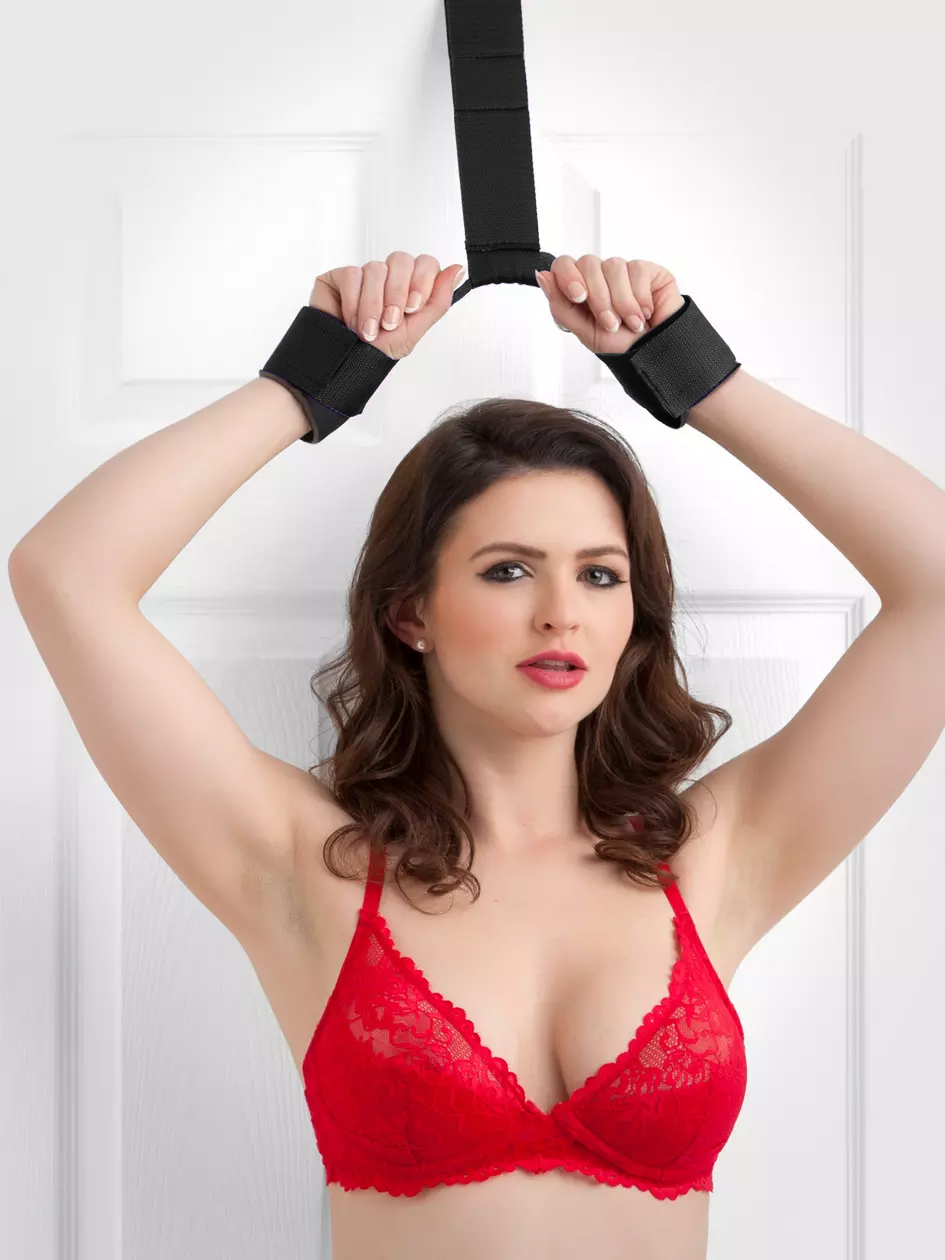
| 197 | The Sacred Arch | Standing | Expert Only | Leather Handcuffs → |
| 198 | Fitting On the Sock | Kneeling | All Couples | Bridal Lingerie → |
| 199 | Nefzawi's Knot | Seated | Signature Position | Collar & Leash → |
| 200 | The Fourth Posture | Kneeling | Intermediate | French Maid Costume → |
Shop by Category
Reading a 600-Year-Old Manual Today
What survives best in al-Nafzawi's catalogue isn't the acrobatics — it's the small practical notes: put a pillow under her hips, put a cushion under his knees, lean against the wall. A 15th-century author writing about comfort and mechanics rather than performance is the part that still reads as genuinely useful. Part 2 continues the chapter with the remaining positions.
Frequently Asked Questions
What is The Perfumed Garden?
The Perfumed Garden of Sensual Delight is a 15th-century Arabic manual by Muhammad ibn Muhammad al-Nafzawi, believed written between 1410 and 1434. Alongside its catalogue of positions it covers attraction, sexual health, remedies for sexual difficulties, and even the interpretation of dreams — making it a work of early sexology rather than merely an erotic text.
How does it compare to the Kamasutra?
Both are classical manuals treating sexual knowledge as a subject worthy of scholarship, and both emphasise compatibility between partners — a point modern sexologists still endorse. The Perfumed Garden is roughly a thousand years younger, written in Arabic rather than Sanskrit, and takes a more practical, remedy-focused approach where the Kamasutra is broader and more philosophical.
Is the text biased toward the male perspective?
Critics have long noted that it is, reflecting the Arabian society al-Nafzawi wrote within. That said, the text does insist a man must genuinely win a woman rather than expect compliance, and several positions here — The Mistress and The Inversion in particular — explicitly hand her full control of the encounter.
How did the book reach English readers?
Through Sir Richard Francis Burton's 1886 translation, the same explorer-scholar who translated the Kamasutra into English. Burton himself compared the work to the French text Conjugal Love by Nicolas Venette.
Which of these positions should beginners try first?
The First Posture (183) and Fitting On the Sock (198) require no strength, flexibility or equipment beyond a pillow. The Sacred Arch (197) and Meeting of the Organs (184) sit at the opposite end and are worth approaching only with real fitness and no sense of obligation.
Is delivery from Condombazaar discreet?
Completely. Every order ships in plain, unmarked packaging with sender name CA Gain Healthcare — no product name or brand visible anywhere on the box. Delivering privately across India since 2010.
Related Guides
Was this guide useful? Share it: